Grain-Free vs Grain-Inclusive Dog Food: What the Evidence Says in 2026
Grain-free was the fastest-growing shelf in pet food until the FDA started asking questions about dog hearts. Eight years on, here is where the investigation actually stands, who should feed which, and how to switch a dog either way without wrecking its stomach.
1. What "grain-free" actually means on the bag
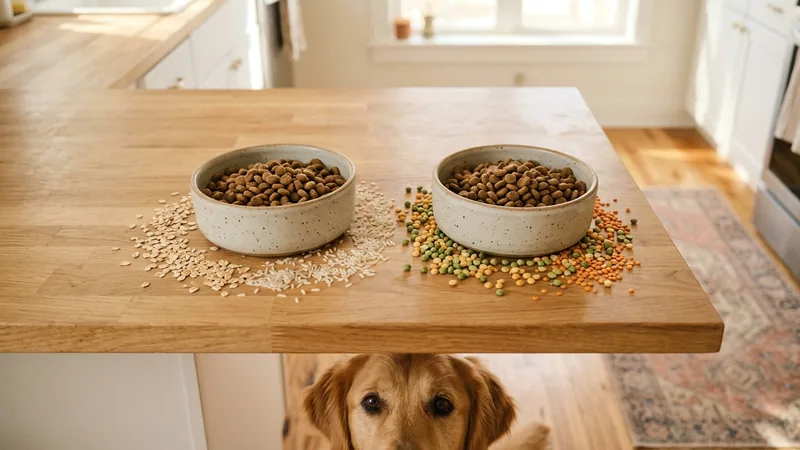
A grain-free kibble is not a low-carbohydrate kibble. Extruded dry food needs starch to hold its shape, so when a recipe drops rice, corn, wheat, oats or barley it substitutes something else: usually peas, lentils, chickpeas (together called pulses), potatoes or sweet potatoes. AAFCO's labelling guide treats "grain-free" as a simple absence claim; it says nothing about protein quality, digestibility or whether the food was tested in real dogs. Grain-inclusive foods use the traditional starches, and the good ones from makers with in-house nutritionists have decades of feeding data behind them. Neither label is a nutrition credential. The AAFCO statement and the manufacturer's track record are, which is the same test we apply in our label guide.
2. The FDA investigation, honestly
In July 2018 the FDA announced it was looking into reports of dilated cardiomyopathy (DCM), a disease where the heart muscle weakens and stretches, in breeds that do not usually get it. DCM is well known as a genetic disease in Dobermans, Great Danes and other big dogs; what was odd was golden retrievers, mixed breeds and small dogs turning up with it, many of them eating the same kind of food. By the June 2019 update the agency had 515 dog reports, more than 90 percent of the diets involved were grain-free, and roughly 93 percent contained peas or lentils. The FDA published the brand names that appeared most often. It was a count of reports, not proof of cause, and the FDA said so.
Then the investigation went quiet in public. In December 2022 the FDA said it would not issue further public updates until it had meaningful new science, added a cumulative count of dog reports (well over a thousand by late 2022) to its question-and-answer page, and confirmed the investigation was not closed. That page was refreshed again in 2024 and notes that reports continue to arrive, at lower levels than the 2018 to 2020 peak. So the status, in plain words: open, unresolved, and not actively updated.
What the research has done since is more useful than the silence suggests. Tufts University's veterinary nutrition team, whose June 2026 update is the most current expert summary, still describes diet-associated DCM as a real, unexplained secondary form of the disease. Their prospective work found that dogs with DCM on non-traditional diets (grain-free and pulse-heavy) had normal taurine levels, so taurine does not explain it, and that they improved more after a diet change than dogs on traditional diets. On the other side of the ledger, a 2022 analysis by BSM Partners and the University of Missouri found no national rise in DCM diagnoses between 2000 and 2019 while grain-free sales grew about 500 percent. And in September 2026 the Dog Aging Project published an analysis of nearly 50,000 dogs in Veterinary Medicine and Science that found grain-free status did not predict new owner-reported heart diagnoses over two years; the authors themselves flag that owners often misclassified what they fed and that the outcomes were owner-reported rather than confirmed by echocardiogram.
Our reading of all that: there is no proven mechanism and no proven population-level risk, but there is a persistent cluster of cases in atypical breeds, concentrated in pulse-heavy grain-free formulas, that got better when the food changed. That is not nothing. It is also not a reason to panic if your dog has thrived on grain-free for years. It is a reason to choose the default carefully.
3. Who should feed grain-inclusive
- Most dogs, most of the time. There is no documented benefit of grain-free for a healthy dog, and grain allergy is rare. In the largest review of confirmed canine food allergies the leading triggers were beef, dairy and chicken; wheat was the only grain that appeared often.
- Breeds and mixes in the DCM reports: golden retrievers, Labradors, mixed breeds, Great Danes and any dog with a family history of heart disease. Here the downside of being wrong is large and the upside of grain-free is nil.
- Puppies and large-breed puppies. Growth is the period where formulation errors show up fastest. Stick with feeding-trial-backed growth foods; see our puppy review.
4. Who might reasonably feed grain-free
- A dog with a grain reaction confirmed by an elimination trial. Not a saliva test, not a hunch: an 8 to 12 week trial with your vet that pointed at wheat or another specific grain. Even then, a single-grain recipe (rice only, for example) often solves it without going fully grain-free.
- A dog whose vet has recommended it for a specific reason, such as a therapeutic diet that happens to be grain-free.
- A dog already doing well on it, with eyes open. If you stay grain-free, prefer a formula where pulses are not stacked in the first five ingredients, from a maker that runs AAFCO feeding trials and employs a veterinary nutritionist, and tell your vet so heart checks can be part of routine visits. Early diet-associated DCM is often silent; a lethargic dog, a new cough, fainting or fast breathing at rest is a same-week vet visit.
5. How to switch, either direction
Abrupt changes cause vomiting, diarrhoea and refused meals that get blamed on the new food. AAHA's owner guidance is a seven-day transition starting at 25 percent new food; we suggest 7 to 10 days for most dogs and up to two weeks for sensitive ones. Days 1 to 3: 25 percent new, 75 percent old. Days 4 to 6: half and half. Days 7 to 9: 75 percent new. Day 10: all new. If stools soften at any step, hold that ratio for two more days before moving on. Change nothing else during the switch, including treats and toppers, so you can read the result. Going from grain-free to grain-inclusive, expect slightly larger stools for a week as fibre sources change; going the other way, expect more gas, since pulses ferment. If a dog is being switched off grain-free because of a suspected heart problem, ask the vet whether to skip the gradual ramp; they may want the new diet in place immediately. For grain-inclusive foods that pass our label tests, start with the best dry dog food review.
The Lab's position: grain-inclusive from a maker with feeding trials is the default until a vet gives you a reason to leave it. Grain-free is not poison, but it carries an unresolved question mark and no proven benefit, and "no proven benefit plus a question mark" is not a trade we would make for a dog we love.
Quick answers
Is the FDA grain-free dog food investigation over?
No. The FDA stopped issuing public updates in December 2022 but did not close the investigation, and it still logs reports. No cause has been proven, and a large 2026 Dog Aging Project analysis found grain-free status did not predict new owner-reported heart diagnoses. Vet cardiologists at Tufts still see cases. Unresolved is the honest word.
Which dogs should eat grain-free dog food?
Dogs with a grain sensitivity confirmed by an elimination trial with a vet, which is rare, and dogs whose vet has recommended it for a specific reason. For everyone else a grain-inclusive food from a maker that runs feeding trials is the lower-risk default.
How do I switch my dog from grain-free to grain-inclusive food?
Over 7 to 10 days. Mix 25 percent new food for two or three days, then 50, then 75, then 100 percent, stretching each step if stools soften. Dogs with sensitive digestion can take two weeks. Keep everything else, including treats, unchanged so you can read the result.
Sources
- FDA — investigation into potential link between certain diets and canine DCM (update history)
- FDA — questions and answers on non-hereditary DCM in dogs, including report counts
- Tufts Petfoodology (Freeman) — update on diet-associated DCM, June 2026
- Veterinary Medicine and Science (Dog Aging Project, 2026) — grain-free diets not predictive of new owner-reported cardiac diagnoses